Best Multivitamin for Men: A UK Buyer's Checklist
The men's multivitamin shelf is crowded with bold claims — “performance”, “power”, “ultimate”. Underneath the marketing, most formulas are built from the same 20 or so vitamins and minerals, and the real differences are in the details: which nutrients are included, at what doses, and what's deliberately left out. This checklist walks through what the research shows, what to look for on the label, and the red flags that tell you to put a bottle back.
Table of Contents
- Do Men Need a Multivitamin at All?
- What the Largest Trials Show
- The 8-Point Label Checklist
- Key Nutrients at a Glance
- Red Flags
- Taking Other Supplements Too? Check the Totals
- FAQ
Do Men Need a Multivitamin at All?
Food comes first, and a varied diet covers most needs. But real life gets in the way of the ideal plate. A multivitamin is most useful as an insurance policy if you:
- eat a limited or repetitive diet, skip meals, or rely on convenience food
- rarely eat oily fish, dairy or fortified foods
- follow a vegan or vegetarian diet (vitamin B12 and iodine are the usual gaps)
- get little sunlight — in the UK, vitamin D is a concern for almost everyone from October to March
- train hard or work long, irregular hours
What a multivitamin cannot do is cancel out a poor diet, poor sleep or no exercise. Think of it as filling small gaps consistently, not as a performance booster.
What the Largest Trials Show
The best long-term evidence in men comes from the Physicians' Health Study II, which followed 14,641 male doctors taking a standard daily multivitamin or a placebo for a median of 11 years.
- In results published in JAMA (Gaziano et al., 2012), the multivitamin group had a modest but statistically significant 8% lower rate of total cancer.
- A companion paper, also in JAMA (Sesso et al., 2012), found no effect on major cardiovascular events such as heart attack or stroke.
More recently, the US COSMOS trial looked at cognition. A 2024 analysis in the American Journal of Clinical Nutrition, pooling three COSMOS sub-studies of adults aged 60 and over, found a small but clear benefit of a daily multivitamin on overall cognition and episodic memory.
The honest reading: a daily multivitamin is a sensible, low-risk habit with modest long-term benefits in large trials — not a cure-all. That makes the quality of the formula, rather than the size of its promises, what matters most.
The 8-Point Label Checklist
- Iron-free, unless you've been told you need iron. More on this below.
- Sensible vitamin D. Look for a clear amount of vitamin D3, typically 10–25µg (400–1000 IU) in a multivitamin.
- Zinc and selenium. Zinc contributes to normal fertility and reproduction and to the maintenance of normal testosterone levels in the blood; selenium contributes to normal spermatogenesis. Both also contribute to normal immune function.
- The B vitamins, including B12. Vitamins B6, B12 and folate contribute to the reduction of tiredness and fatigue, and to normal energy-yielding metabolism.
- Doses close to 100% NRV. NRV is the daily reference amount. Formulas mostly near 100% are designed to fill gaps; many lines at 1000%+ are designed to impress on the label.
- Vitamin A within limits. Check the vitamin A figure and see the liver advice below.
- Iodine and magnesium. Often under-supplied in diets low in dairy and fish; many cheap formulas leave them out or include token amounts.
- A format you'll actually take. One large tablet or two smaller ones? Consistency beats everything, so choose the format that fits your routine.
Why many men's formulas are iron-free
The NHS states that men need 8.7mg of iron a day — an amount most men get from food. It also notes that high doses of iron (over 20mg) can cause constipation, nausea and stomach pain. Unless a GP has diagnosed low iron, an iron-free men's formula avoids adding iron you probably don't need. If you have been diagnosed with iron deficiency, follow your GP's advice rather than relying on a multivitamin.
Key Nutrients at a Glance
| Nutrient | Officially recognised role | What to look for |
|---|---|---|
| Vitamin D3 | Normal immune function, muscle function, bones | Stated in µg and IU; mind your total from all products |
| Zinc | Normal testosterone levels, fertility, immunity | Around 10–15mg |
| Selenium | Normal spermatogenesis, immune function | Around 55µg (100% NRV) |
| Vitamin B12 | Reduction of tiredness and fatigue | Especially important on vegan diets |
| Magnesium | Normal muscle function, reduction of fatigue | A meaningful amount, not a token trace |
| Iodine | Normal thyroid function and energy metabolism | Around 150µg (100% NRV) |
| Iron | — | Absent in most men's formulas, by design |
For a broader look at how vitamins and minerals interact, our practical UK guide to multivitamins and minerals and our article on zinc and vitamin pairings go deeper.
Red Flags
- “Proprietary blend” with no amounts per ingredient
- Megadoses of several nutrients far above 100% NRV with no clear reason
- Medical-sounding promises — food supplements in the UK can't claim to treat or prevent disease
- No company name or UK address on the pack
- No manufacturing standards stated, such as GMP
Our checklist on how to read a supplement label covers these in more detail.
Taking Other Supplements Too? Check the Totals
This is the most common mistake we see: adding a multivitamin on top of separate supplements without checking the overlap.
- Vitamin D: the NHS advises adults not to take more than 100µg (4000 IU) a day in total. If you already take a high-strength vitamin D, add up the vitamin D in your multivitamin too — a 4000 IU product plus a multivitamin with 1000 IU takes you above that limit. In that case, take the high-strength vitamin D on its own, or use the multivitamin alone. Our guide to vitamin D3 and K2 explains the limits.
- Vitamin A: the NHS advises that if you eat liver or liver products such as pâté every week, you shouldn't take supplements containing vitamin A. Fish liver oils also contain vitamin A.
- Zinc: if you also take a standalone zinc supplement or a men's herbal formula with zinc, check your daily total.
FAQ
Morning or evening? Whichever you'll remember, but always with food: fat-soluble vitamins (A, D, E, K) absorb better with a meal, and minerals are gentler on the stomach. See the best time to take vitamins.
Is a men's formula really different from a standard one? The best ones are: typically iron-free, with meaningful zinc and selenium. A unisex formula with iron isn't wrong, but it may include iron you don't need.
Will a multivitamin give me more energy? Only if you're short of the nutrients involved in energy metabolism, such as B vitamins, iron or magnesium. If you're already well nourished, don't expect a lift — and persistent tiredness is worth discussing with a GP.
Can it help with fertility? Zinc and selenium have recognised roles in normal fertility and sperm production. If you're trying for a baby, our men's fertility vitamin guide covers the evidence.
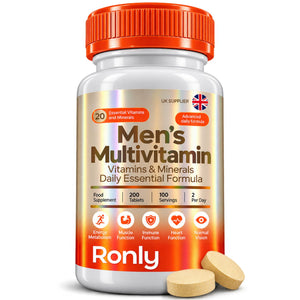
If you want a formula that ticks this checklist, Ronly Men's Multivitamin provides 20 nutrients in two small tablets a day — including vitamin D3 25µg (1000 IU), zinc 11mg, selenium 55µg, iodine 150µg, magnesium 120mg and vitamin B12 6.24µg, plus 300µg of lycopene from tomato — with no added iron. 200 tablets make a 100-day supply; gluten and lactose free, made to GMP and HACCP standards for Ronly Health Limited, UK.
Food supplements should not be used as a substitute for a varied and balanced diet and a healthy lifestyle. This article is general information, not medical advice.