Omega-3 EPA vs DHA: How to Read a Fish Oil Label
Pick up any two fish oil bottles in a UK pharmacy and you'll see a confusing spread of numbers: 1000mg, 1200mg, “triple strength”, 2500mg. Very few of them tell you the two figures that actually matter — how much EPA and DHA you get in a daily serving. This guide explains what EPA and DHA are, what the largest trials really found, how to read a fish oil label in under a minute, and how to tell a fresh, honest product from a tired one.
Table of Contents
- EPA, DHA and ALA: The Three Omega-3s
- What EPA and DHA Are Officially Recognised For
- What the Big Trials Actually Found
- How to Read a Fish Oil Label in 60 Seconds
- Freshness: The Quality Problem Nobody Mentions
- How Much Do You Need?
- Safety and Who Should Ask First
- FAQ
EPA, DHA and ALA: The Three Omega-3s
“Omega-3” is a family name, not a single nutrient. Three members matter for everyday nutrition:
| Omega-3 | Main source | What to know |
|---|---|---|
| EPA (eicosapentaenoic acid) | Oily fish, fish oil | Long-chain; the omega-3 most associated with heart research |
| DHA (docosahexaenoic acid) | Oily fish, fish oil, algae oil | Long-chain; a structural fat in the brain and the retina of the eye |
| ALA (alpha-linolenic acid) | Flaxseed, walnuts, rapeseed oil | Plant omega-3; the body converts only a small share into EPA and DHA |
That last row is why a plant-only diet rich in flaxseed is not a like-for-like swap for oily fish. If you want EPA and DHA themselves, the practical sources are oily fish, fish oil or — for vegans — algae oil, which provides mainly DHA. Our article on linseeds and flaxseeds covers the plant side in more detail.
What EPA and DHA Are Officially Recognised For
In the UK, food supplements can only use health claims that have been formally authorised. For EPA and DHA these are:
- EPA and DHA contribute to the normal function of the heart — the beneficial effect is obtained with a daily intake of 250mg of EPA and DHA.
- DHA contributes to the maintenance of normal brain function — with a daily intake of 250mg of DHA.
- DHA contributes to the maintenance of normal vision — with a daily intake of 250mg of DHA.
Those 250mg thresholds are useful: they give you a concrete number to check against the label, rather than the size of the capsule. For more on the brain side, see our piece on omega-3 and brain function.
What the Big Trials Actually Found
Omega-3 headlines swing between “miracle” and “useless”. The large trials tell a more measured story.
VITAL (2018). The VITAL trial in the New England Journal of Medicine gave 25,871 adults either 1g of marine omega-3 a day or a placebo for a median of 5.3 years. Omega-3 did not reduce the combined rate of major cardiovascular events or cancer in this general population. One secondary finding stood out — fewer heart attacks in the omega-3 group — but secondary results are treated as signals, not conclusions.
REDUCE-IT (2018). The REDUCE-IT trial found a 25% relative reduction in cardiovascular events — but it used 4g a day of a purified, prescription EPA medicine in patients with raised triglycerides who were already on statins. It tells us about a specific drug in a specific group, not about everyday fish oil supplements.
Cochrane review (2020). A Cochrane review of 86 randomised trials and over 160,000 people found little or no effect of increasing long-chain omega-3 on overall mortality or cardiovascular events, with low-certainty evidence that it may slightly reduce coronary heart disease events.
The honest reading: fish oil is not a heart treatment. Its strongest, best-supported role is as a reliable way to get EPA and DHA if you rarely eat oily fish — which, according to the NHS, applies to most people in the UK.
How to Read a Fish Oil Label in 60 Seconds
Ignore the big number on the front and go straight to the nutrition panel. Here's what each line tells you:
| Label line | What it really means |
|---|---|
| Fish oil 1000mg | The total oil in the capsule — not the omega-3. A standard 1000mg capsule typically contains around 300mg of omega-3. |
| Total omega-3 | All omega-3 fats combined, including minor ones beyond EPA and DHA. |
| EPA and DHA | The two figures that matter. Add them together and compare with the 250mg reference above. |
| Per serving (2 softgels) | Check how many capsules make one serving before comparing bottles. |
| Source fish | Small fish such as anchovies and sardines sit low in the food chain. |
| Antioxidant added | Vitamin E (tocopherol) or rosemary extract help protect the oil from going rancid. |
Per capsule vs per serving
This is where most comparisons go wrong. A bottle advertising “1000mg” per capsule with a two-capsule serving is not the same as one listing 1800mg of omega-3 per serving. A simple method: work out EPA + DHA per day for each product, then divide the price by the number of days in the bottle. That gives you a true cost per day of the nutrients you're actually buying. Our wider guide on how to read a supplement label uses the same approach for other products.
Freshness: The Quality Problem Nobody Mentions
Omega-3 fats are fragile and oxidise when exposed to heat, light and air. A 2015 study in Scientific Reports tested every encapsulated fish oil sold in New Zealand: only 3 of 32 products contained at least the EPA and DHA stated on the label, and most exceeded recommended oxidation limits. Strikingly, best-before date, price and country of origin were all poor predictors of quality.
You can't run a lab test at home, but you can stack the odds in your favour:
- Choose transparent labels that state EPA and DHA per serving, the fish source and an added antioxidant.
- Do the smell test on a new bottle — a strong, sharp, rancid smell is a warning sign (a light lemon flavour is fine).
- Store it properly: lid closed, cool and dark, away from the cooker. Our guide to storing supplements correctly explains why.
- Finish an opened bottle within a reasonable time rather than keeping it for months on a warm shelf.
How Much Do You Need?
The NHS recommends at least two portions of fish a week, one of them oily — a portion being around 140g — and notes that most people don't eat this much. Food comes first: salmon, mackerel, sardines, herring and trout are all excellent sources.
A supplement makes the most sense if you rarely eat oily fish. In that case, aim for a product that clearly provides at least 250mg of EPA and DHA a day — the level linked to normal heart function — and at least 250mg of DHA for the brain and vision claims. Higher-strength formulas simply get you there in fewer capsules.
Safety and Who Should Ask First
Fish oil is well tolerated by most adults, and VITAL reported no excess bleeding risk at 1g a day. Speak to a GP or pharmacist first if you:
- take blood-thinning medicines such as warfarin, or have a bleeding disorder
- have a fish or seafood allergy
- are pregnant or breastfeeding — and avoid fish liver oils such as cod liver oil unless advised, as they also contain vitamin A
- are due to have surgery
Fishy burps are the most common complaint. Taking softgels with a meal usually solves it — see our guide on the best time to take supplements.
FAQ
Is EPA or DHA better? Neither — they do different jobs. EPA is the focus of heart research; DHA is a structural fat in the brain and eyes. Most people are best served by a fish oil that provides both.
Is cod liver oil the same as fish oil? No. Cod liver oil comes from the liver and also contains vitamins A and D, so it's easier to overdo vitamin A. Fish body oil from anchovies and sardines provides omega-3 without that extra vitamin A.
Does “triple strength” mean anything? It usually means about three times the omega-3 of a standard 1000mg capsule (around 300mg). Always confirm by reading EPA and DHA per serving.
How long before I notice anything? Omega-3 builds up in the body over weeks. It's a long-term dietary habit, not a quick fix.
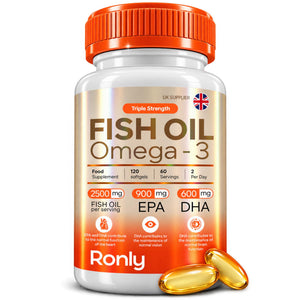
If you're looking for a transparent high-strength option, Ronly Omega-3 Fish Oil Triple Strength states everything this guide says a good label should: per 2-softgel serving, 2500mg fish oil providing 1800mg omega-3, including 900mg EPA and 600mg DHA, from anchovies and sardines, protected with natural vitamin E and rosemary extract, with a light lemon flavour. 120 softgels give a two-month supply; made to GMP and HACCP standards for Ronly Health Limited, UK.
Food supplements should not be used as a substitute for a varied and balanced diet and a healthy lifestyle. This article is general information, not medical advice.