Vegan Multivitamin UK: The Complete Buyer Guide
You're standing in a UK health-food shop, holding two bottles that both promise “vegan multivitamin” support. One lists a long parade of ingredients in tiny print. The other highlights B12, vitamin D and iodine, but you're still unsure whether the amounts are useful, whether the capsule is genuinely vegan, or whether the label meets UK requirements.
The answer isn't to choose the bottle with the most impressive front-of-pack language. A better approach is to read the product as a practical nutrition plan. Check which nutrients are relevant to your diet, identify the amount supplied per recommended daily dose, confirm the manufacturing information, and make sure the formula complements rather than replaces varied meals.
Table of Contents
- Why UK Shoppers Are Switching to Vegan Multivitamins
- Essential Nutrients to Check in Plant-Based Formulas
- Reading UK Supplement Labels Like an Expert
- Understanding GMP and HACCP Quality Standards
- Finding Reliable Vegan Supplements Online
- Building a Sustainable Daily Wellness Routine
Why UK Shoppers Are Switching to Vegan Multivitamins
The person comparing bottles may be vegan for ethical reasons, concerned about animal-derived ingredients, or looking for a straightforward supplement that fits a plant-based routine. Some shoppers also prefer formulations that avoid unnecessary animal ingredients such as gelatin and use clearly identified plant-compatible sources. Those preferences matter, but they don't tell you whether a product is nutritionally well designed.
A vegan multivitamin earns its place by addressing realistic gaps. Vitamin B12 is the clearest example. Plant-based meals can be rich in fibre, legumes, wholegrains, fruit, vegetables and fortified foods, yet reliable B12 intake still requires deliberate planning. UK evidence among women of childbearing age found median dietary B12 intake of 0.9 micrograms in vegans, compared with 2.0 micrograms in omnivores. Even with supplements included, the vegan median was 1.2 micrograms, compared with 5.2 micrograms among omnivores. The UK analysis of B12 status and intake also recorded supplement use and biomarker findings that reinforce the need for consistent coverage.

A supplement should solve a specific problem
Vitamin D creates a second UK-specific consideration. Limited sunlight, indoor routines and a plant-based diet can make year-round planning relevant for some people. NHS-linked guidance says UK adults should consider 10 micrograms, or 400 IU, daily during autumn and winter, while people at higher risk, including those following vegan diets, may need to consider supplementation throughout the year. UK vitamin D guidance gives the context behind that recommendation.
That doesn't mean every vegan needs an oversized formula. It means the front label should lead you towards the ingredient panel, not replace it. A sensible product makes the form and amount easy to find, explains the daily serving, and avoids implying that a tablet can compensate for an unbalanced diet.
Consumers are also looking for products that fit an organised routine. A single daily serving can be useful if it reduces the number of separate decisions you make, but convenience shouldn't hide weak formulation. Use this guide to daily vitality and nutritional needs as a reminder to assess the whole routine, including meals, sleep, activity and any prescribed treatment.
Practical rule: Choose a vegan multivitamin because its label answers your nutritional needs, not because its packaging uses the most fashionable plant-based language.
Essential Nutrients to Check in Plant-Based Formulas
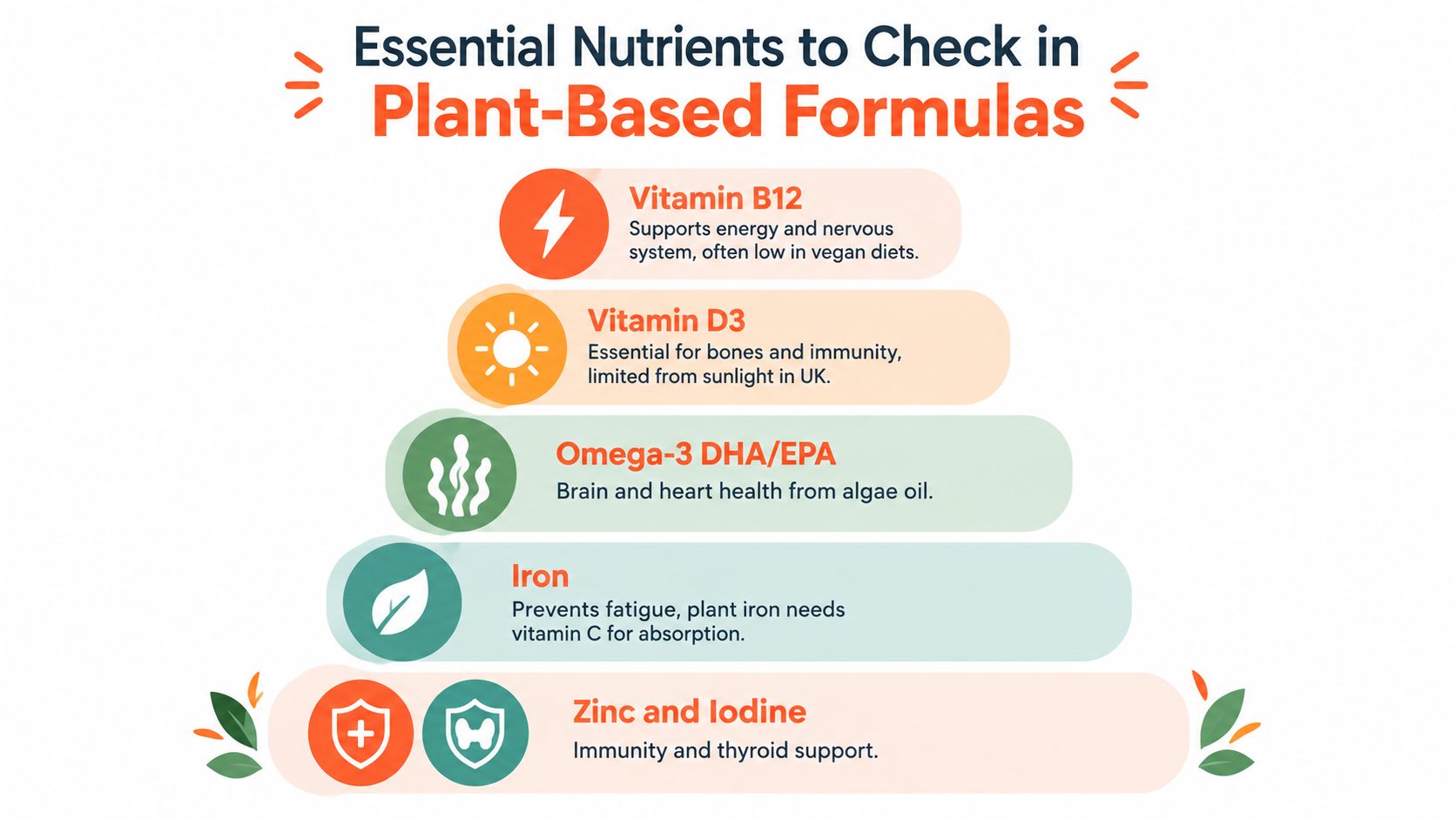
A long ingredient list can look reassuring, but the important question is whether the formula covers the nutrients most likely to need deliberate planning. UK NHS guidance identifies vitamin B12, vitamin D, iodine, selenium and calcium as nutrients vegans may need to obtain through fortified foods or supplements, while poor planning can also affect iron intake. The NHS vegan diet guidance is a useful starting point because it places supplements alongside food choices rather than treating them as a replacement.
Start with B12
B12 deserves the closest inspection. The British Dietetic Association says vegans should rely on fortified foods and supplements and recommends at least 10 micrograms per day of B12. Its guidance also notes that high folate status can mask B12 deficiency, so feeling well or eating plenty of leafy greens doesn't prove that B12 status is adequate. A 2024 meta-analysis found lower serum B12 and higher homocysteine in vegan adults than in omnivores, supporting the importance of functional status rather than intake alone. BDA nutritional considerations for vegan diets explains the product-design implication clearly: B12 shouldn't be added merely to make a formula look complete.
Look for the amount per recommended serving and the chemical form. Cyanocobalamin and methylcobalamin are both familiar supplement forms, but the label should identify which one is present. If supplementation has been inconsistent, discuss testing and an appropriate replacement plan with a GP or dietitian rather than assuming a standard multivitamin will correct an established problem.
Assess vitamin D for the UK, not an imaginary climate
Vitamin D is influenced by sunlight exposure, season, skin pigmentation, indoor time, body composition, malabsorption and diet. Vegan shoppers should confirm that the source is compatible with their diet. Vitamin D2 is plant-derived, while vegan D3 is commonly produced from lichen rather than animal sources. The product should state the form instead of leaving you to guess from the word “vegan”.
The NHS-linked population guidance uses 10 micrograms daily as the autumn and winter reference point, while people in higher-risk groups may need supplementation across the year. A preventive multivitamin isn't a treatment course for diagnosed deficiency. If a clinician identifies deficiency, follow the prescribed plan.
Don't overlook iodine and selenium
Iodine supports normal thyroid function, yet vegan diets can miss it when dairy and fish are absent and fortified plant milks aren't used. Kelp can appear attractive on a label, but the amount should be clearly stated and consistent with the product's serving guidance. Selenium also deserves a deliberate check, especially if the diet contains few reliable sources.
Iron, calcium and zinc need a food-first assessment. Legumes, tofu, seeds, fortified foods and wholegrains may contribute, but individual needs vary. Iron supplementation is especially unsuitable as an automatic purchase because unnecessary iron can be inappropriate, while low iron should be investigated with suitable clinical tests.
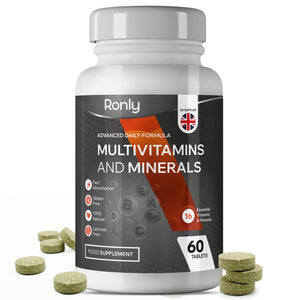
A product such as Ronly Multivitamins & Minerals presents a broad daily formula with listed amounts for B12, vitamin D, iron, zinc and iodine. Its label snapshot lists 2.5 micrograms of B12, 5 micrograms of vitamin D, 14 milligrams of iron, 5 milligrams of zinc and 150 micrograms of iodine per stated serving. That makes comparison possible, but it also shows why “contains B12” isn't the same as meeting every vegan-specific recommendation. The product is described as suitable for vegetarians and vegans and manufactured in the UK under GMP and HACCP standards.
A short video can help visual learners understand the role of common nutrients before they return to the label.
For a separate explanation of vitamin D amounts and product comparison, read this vitamin D supplement guide. The useful habit is to compare the stated amount with your own diet, season and risk factors, then ask a healthcare professional when your circumstances fall outside ordinary self-care.
Reading UK Supplement Labels Like an Expert
The front of a bottle is marketing. The legally required information is where you make the buying decision. In England, food supplements are governed by the Food Supplements (England) Regulations 2003, with equivalent regulations applying in Scotland, Wales and Northern Ireland. The English rules came into force on 1 August 2005. The legislation.gov.uk text sets out the core label requirements.
Use a five-point label scan
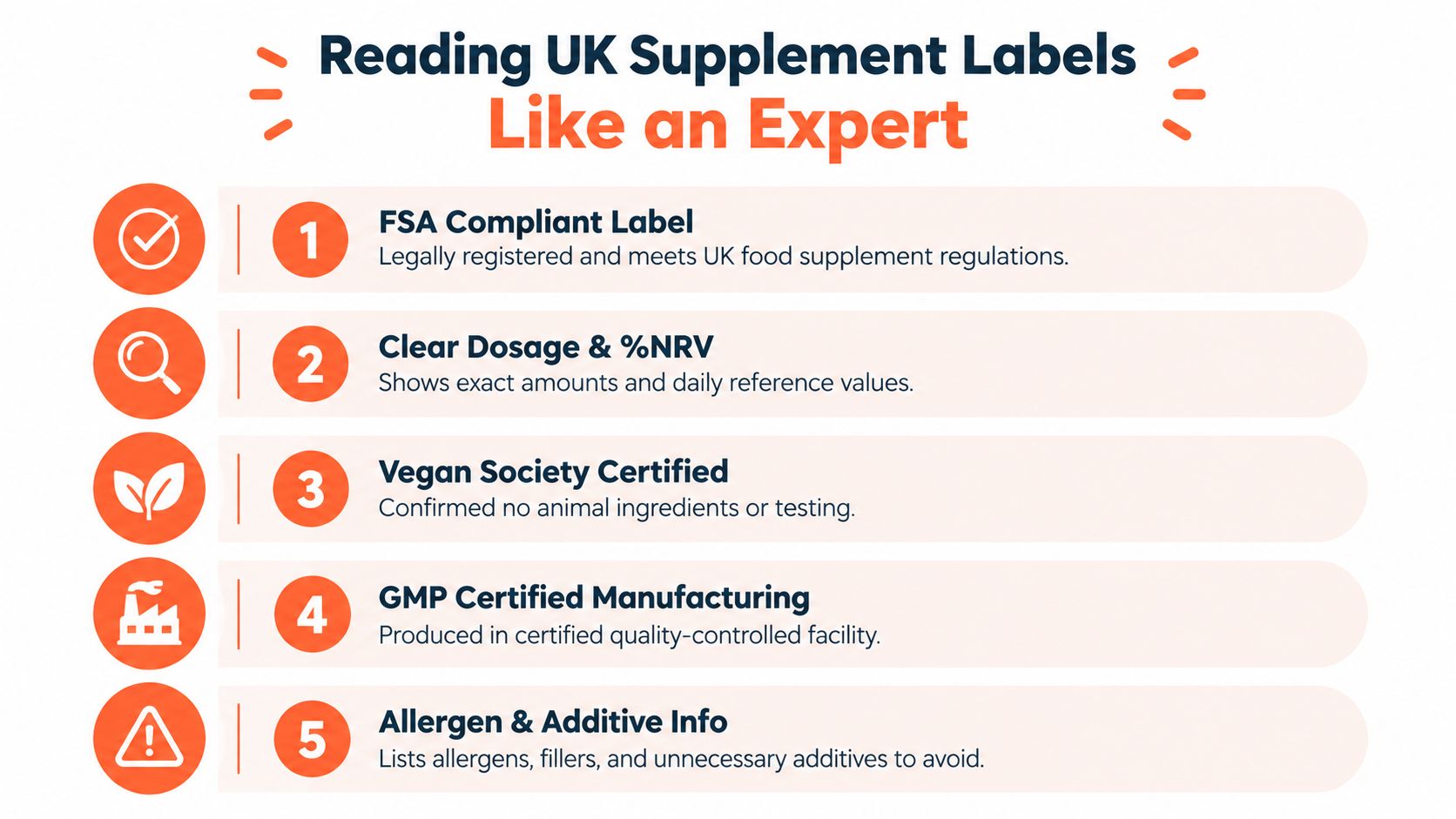
- Identify the nutrient category. The label should identify the vitamin or mineral category supplied. This helps you distinguish a named nutrient from a vague botanical blend and makes comparisons between products more reliable.
- Find the recommended daily dose. Check whether the listed amounts apply to one tablet, several capsules or another serving. A high-looking amount may be spread across multiple units, while a lower number may be the amount in a single daily serving.
- Read the amount of each nutrient. UK rules require the amount of each relevant nutrient to appear. Look for units such as micrograms or milligrams, and don't compare figures until you've confirmed that the units match.
- Check the warnings. The label must warn users not to exceed the recommended dose. It must also advise that supplements be stored out of the reach of young children.
- Look for the diet statement. UK supplement labels must state that supplements shouldn't replace a varied diet. That sentence matters because a multivitamin is a nutritional support product, not a substitute for meals containing protein, fibre, carbohydrate, fats and a broad range of plant foods.
The label should also provide storage advice. Keep the container according to those instructions, close it properly and avoid transferring tablets into an unlabelled box if that could remove important directions or warnings.
Separate legal compliance from quality claims
A compliant label establishes a baseline. It doesn't automatically prove that a product is ideal for your diet, that every ingredient is present in a dose you want, or that a “clean” claim has a useful nutritional meaning. You still need to inspect the ingredient forms, serving size, allergens, additives, vegan suitability and manufacturer details.
This practical supplement-label guide can help you turn that inspection into a repeatable habit. If you're comparing a multivitamin with a separate botanical product, keep their purposes distinct. Ronly Drive, for example, is described as a men's daily wellness supplement containing maca, tribulus, rhodiola, zinc, vitamin B6 and vitamin B12. That isn't the same product category as a vegan multivitamin designed to address a wider range of vitamins and minerals.
Read the daily serving first. Ingredient names attract attention, but the amount supplied per recommended dose tells you what you're actually buying.
Understanding GMP and HACCP Quality Standards
A vegan claim answers one question: whether the product is intended to exclude animal-derived ingredients. It doesn't answer how the manufacturer controls raw materials, mixing, filling, packaging or batch consistency. That's where manufacturing standards become relevant.
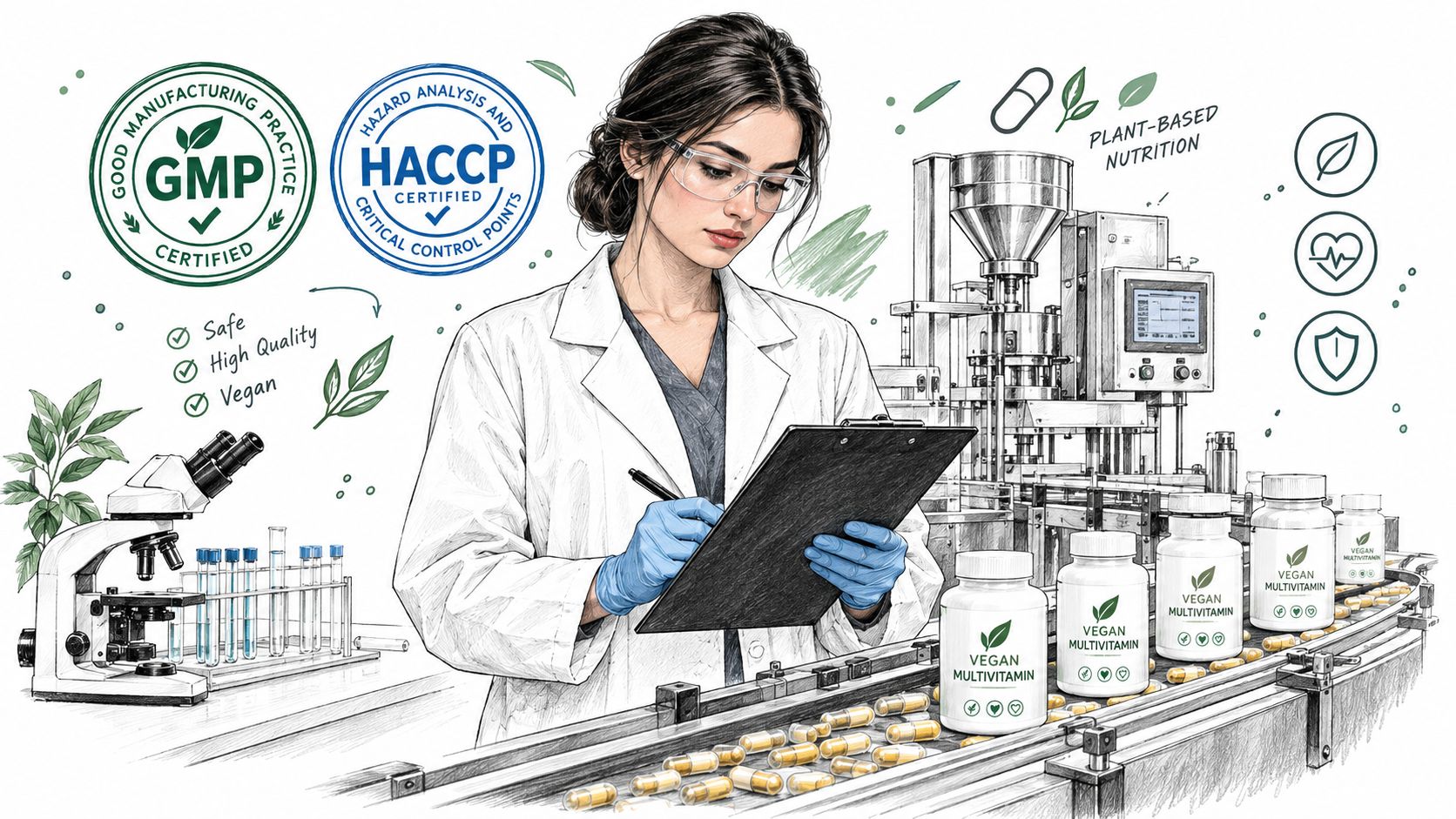
Good Manufacturing Practice, or GMP, refers to controlled production processes designed to support consistent identity, quality and dosing. In practical terms, the manufacturer should be able to manage how ingredients are received, stored, weighed, blended and packed. Clear procedures matter because a product can have a well-designed formula on paper but still fail as a reliable supplement if production controls are weak.
Hazard Analysis and Critical Control Point, or HACCP, focuses on identifying hazards and controlling them at important stages. The hazards may be biological, chemical or physical. A HACCP approach asks where contamination or another safety problem could occur, which control should prevent it, and how the manufacturer verifies that control.
Compare what you can verify
When you're assessing a UK-made product against an anonymous marketplace listing, look for practical evidence rather than polished language.
| What to inspect | Why it matters |
|---|---|
| Manufacturer identity | Gives you a responsible party to contact |
| Batch or lot information | Supports traceability |
| Full ingredient panel | Lets you assess dose and suitability |
| Usage and storage directions | Helps you use the product as intended |
| GMP and HACCP information | Shows that production controls are part of the stated process |
| Allergen and diet details | Helps you avoid unwanted ingredients |
UK manufacture doesn't make every product automatically suitable for every person. It does give shoppers a clearer question to ask: can the seller explain where the product is made and which controls apply? An importer or third-party marketplace listing may offer less accessible information, especially if the product page doesn't identify the actual manufacturer.
A vegan-friendly and non-GMO claim is only useful when the company can support it with transparent product information. Check whether the label identifies the capsule or tablet materials, whether the ingredient sources are named, and whether customer support can answer basic questions without directing you back to vague advertising copy.
Quality assurance also includes storage after manufacture. Heat, moisture and sunlight can affect product condition, so follow the stated storage advice rather than keeping tablets loose in a bathroom or next to a kettle.
Finding Reliable Vegan Supplements Online
Online shopping removes the physical bottle from your hands, so your first task is to recreate the label check digitally. Don't begin with the product title. Open the full product page and look for the serving size, complete ingredient list, nutrient amounts, warnings, storage advice and the identity of the seller.
Check the retailer before the formula
Use this sequence:
- Confirm the seller. Look for a business name, contact route and a clear way to ask product questions. A marketplace username alone gives you little context.
- Read the entire ingredient panel. Avoid listings that show only the front label or describe the contents as a proprietary blend without meaningful amounts.
- Challenge broad promises. Statements about guaranteed energy, rapid transformation or treating a condition should make you pause. Food supplements aren't a substitute for diagnosis or treatment.
- Inspect delivery and returns information. Clear policies reduce uncertainty if the wrong item arrives or the packaging is damaged.
- Check the checkout page. A secure, recognisable payment process is preferable to a seller requesting payment through an unrelated message or an unfamiliar route.
- Save the product details. Keep the label, usage instructions and order confirmation so you can check what you bought later.
A direct retailer may also make support resources easier to find. FAQs, returns information, shipping details and customer contact options don't prove nutritional quality, but they show whether the seller has built a usable buying process around the product.
For broader online safety habits, this UK guide to checking supplement sellers offers a useful framework. Although the article's subject is different, the core discipline applies to any supplement purchase: verify the seller, understand the ingredients and avoid products that rely on unsupported promises.
Store the product when it arrives
Keep supplements in their original, closed packaging and follow the storage instructions on the label. A cool, dry cupboard is usually more suitable than a humid bathroom, but the printed directions take priority. Keep the container away from young children and don't combine tablets from different products into one unmarked container.
If the seal is broken, the label is missing, the tablets look different from the product description or the package arrives damaged, contact the seller before using it. Keep a record of the batch information where available, particularly if you need to report a concern.
Building a Sustainable Daily Wellness Routine
The best vegan multivitamin routine is simple enough to maintain and specific enough to make sense. Begin with the nutrients your diet needs attention, then choose a product whose serving size and label are easy to understand. B12 should receive deliberate scrutiny, while vitamin D planning should reflect UK season, sunlight exposure and personal risk factors.
Take the supplement at the same point in your day, perhaps with breakfast or another meal you rarely skip. Consistency is more useful than creating a complicated schedule with several products that you forget. If the label says one tablet daily, don't assume taking more will improve the result. The UK regulations require warnings not to exceed the recommended dose, and that instruction deserves more respect than a marketing claim.
Use this quick decision framework:
- Diet: Are fortified foods and key plant sources part of your normal meals?
- Formula: Does the product provide clearly stated amounts of B12, vitamin D and other nutrients relevant to you?
- Suitability: Is the capsule or tablet compatible with your diet and free from ingredients you need to avoid?
- Quality: Can you identify the manufacturer and understand its GMP and HACCP controls?
- Routine: Can you follow the serving, storage and safety instructions without friction?
- Monitoring: Do symptoms, pregnancy, medication or a diagnosed deficiency mean you should speak with a healthcare professional first?
A multivitamin won't replace varied meals, and it shouldn't be used to self-treat persistent fatigue, tingling, unexplained illness or a confirmed deficiency. If supplementation has been inconsistent or your circumstances are changing, ask a GP, pharmacist or registered dietitian whether testing or a separate supplement is more appropriate.
The confident UK shopper isn't the person who buys the bottle with the longest ingredient list. It's the person who can explain what each priority nutrient is doing, how much the daily serving provides, why the product is suitable for their diet and where to find help if the label raises questions.
Ronly Health Limited offers UK-manufactured, plant-based food supplements, including daily multivitamin and mineral support, with product information designed to make ingredients and usage easier to understand. Visit Ronly Health Limited to explore its educational resources and supplement range, then compare any product against the label-reading checks in this guide.