Can You Take CoQ10 and Fish Oil Together? What the Evidence Says
Omega-3 fish oil and CoQ10 are two of the most popular supplements in the UK, and they often end up in the same cupboard — especially for people in their 40s and 50s, or anyone taking a statin. So it's a fair question: can you take CoQ10 and fish oil together? For most adults, yes. There is no known interaction between the two, and they have been given together in clinical trials. But "safe together" is not the same as "work better together", and a few medicines are worth checking first. This guide explains what each supplement does, what the research on combining them actually found, and how to take them sensibly.
Table of Contents
- The Short Answer
- Omega-3 and CoQ10: What Each One Is
- Why People Take Them Together
- What the Research on Combining Them Found
- Safety, Doses and Medicines to Check
- How to Take CoQ10 and Fish Oil Together
- FAQ
The Short Answer
Yes — healthy adults can usually take CoQ10 and an omega-3 fish oil on the same day, even at the same meal. They don't compete for absorption in a way that matters, and neither cancels the other out. Both are fat-soluble, so taking them with food that contains some fat is the one habit that helps both.
The honest version: combining them is about convenience, not a "synergy". In the best-designed trial that tested each supplement alone and together, the effects came from the omega-3, and adding CoQ10 did not increase them. Take each one for its own reasons.
Omega-3 and CoQ10: What Each One Is
| Omega-3 fish oil | CoQ10 (coenzyme Q10) | |
|---|---|---|
| What it is | Long-chain fatty acids, mainly EPA and DHA, from oily fish | A vitamin-like compound the body makes itself; found in every cell, especially in mitochondria |
| Food sources | Oily fish such as salmon, mackerel, sardines, herring and pilchards | Small amounts in meat, oily fish, nuts and some oils |
| Approved health claims (UK) | EPA and DHA contribute to the normal function of the heart (with 250 mg EPA + DHA a day). DHA contributes to normal brain function and normal vision (with 250 mg DHA a day). | None — there are no authorised health claims for CoQ10 itself |
| Why people supplement | They rarely eat oily fish | Interest in energy metabolism, ageing, and statin use |
The NHS recommends at least two portions of fish a week, including one of oily fish. If that doesn't happen, a fish oil supplement is the practical way to get EPA and DHA. Our guide to omega-3 EPA vs DHA explains how to read the amounts on a fish oil label — the figure that matters is EPA + DHA per serving, not the total "fish oil" milligrams.
CoQ10 is different: your body makes it, so it isn't an essential nutrient in the way vitamins are. That's why it has no approved health claims, and why it's worth being sceptical of any product that promises more than the evidence shows.
Why People Take Them Together
There are three common reasons:
- Statins. Statins block the same pathway the body uses to make CoQ10. A meta-analysis of placebo-controlled trials (Banach et al., 2015) found that statins lowered blood CoQ10 levels by an average of 0.44 µmol/L, across atorvastatin, simvastatin, rosuvastatin and pravastatin. Whether that drop matters clinically is still unclear — our article on CoQ10 and statins covers the evidence on muscle aches in detail.
- Heart-health routines. Many people build a "heart" routine around omega-3 and add CoQ10 because they've read about it. Only the omega-3 carries an approved heart claim, but people often take both.
- Convenience. Both are softgels taken with meals, so they fit easily into the same routine.
What the Research on Combining Them Found
Few studies have tested omega-3 and CoQ10 together, but one research group in Western Australia ran a well-designed trial that did exactly that. Eighty-five adults with moderate chronic kidney disease were randomly given omega-3 (4 g a day), CoQ10 (200 mg a day), both, or a placebo (olive oil) for eight weeks. This "factorial" design shows what each supplement does on its own and whether the combination adds anything.
| What was measured | Omega-3 | CoQ10 | Both together |
|---|---|---|---|
| 24-hour blood pressure and heart rate (Mori et al., 2009) | Lowered (about −3.3/−2.9 mmHg and −4 beats per minute); triglycerides down 24% | No effect on blood pressure; heart rate slightly higher | CoQ10 did not add to the omega-3 effect |
| Markers linked to resolving inflammation (Mas et al., 2015; Barden et al., 2018) | Increased | No change | One marker (myeloperoxidase) fell with omega-3 alone but not when CoQ10 was added |
A separate trial in 50 overweight men (Parker et al., 2019) gave a fish oil providing 588 mg EPA and 412 mg DHA a day, combined with 200 mg CoQ10, for 12 weeks. It did not reduce liver fat or visceral fat compared with placebo — a useful reminder that adding CoQ10 to a fish oil doesn't turn it into something more powerful.
What this means in practice
- Taking them together appears safe and well tolerated — they were given together in these trials without problems.
- There's no good evidence that they boost each other. The measurable effects came from the omega-3.
- These were specific groups (people with kidney disease, overweight men) at specific doses, so the results can't simply be applied to everyone.
So the sensible approach is to decide on each supplement separately: omega-3 if you don't eat oily fish regularly, CoQ10 if you have your own reason to take it (and, ideally, have discussed it with your GP if you take a statin).
Safety, Doses and Medicines to Check
| Omega-3 (EPA + DHA) | CoQ10 | |
|---|---|---|
| Amount linked to the approved claim | 250 mg a day for heart function | No approved claim |
| Amounts used in studies | Commonly 1–4 g a day | Commonly 100–300 mg a day; some studies use more |
| Safety ceiling | EFSA concluded that supplemental EPA + DHA of up to about 5 g a day does not raise safety concerns for adults | Generally well tolerated; mild stomach upset is the most common complaint |
| Medicines to ask about | Warfarin and other blood thinners | Warfarin (CoQ10 may make it work less well), blood pressure medicines, and some cancer treatments |
According to the Mayo Clinic, CoQ10 might make warfarin less effective and might lower blood pressure, so speak to your GP or pharmacist first if you take either type of medicine. The same applies if you are pregnant or breastfeeding, have a long-term condition, or are due to have surgery.
How to Take CoQ10 and Fish Oil Together
- Take both with a meal. CoQ10 and omega-3 are fat-soluble. In a laboratory digestion model, CoQ10 uptake was higher from solubilised forms (such as oil-filled softgels) than from dry powder — eating some fat helps for the same reason.
- Same time or split — both are fine. If your stomach is sensitive, take the fish oil at breakfast and the CoQ10 with your evening meal.
- Check your other supplements. Many CoQ10 and fish oil products contain vitamin E. Add it up if you also take a multivitamin — the NHS says 540 mg or less of vitamin E a day from supplements is unlikely to cause harm. Our guide to combining supplements safely walks through the sums.
- Avoid fish liver oils if you already take vitamin A in a multivitamin. A fish body oil gives you omega-3 without extra vitamin A.
- Be consistent. Linking both to the same daily meal is the easiest way not to forget. See our guide to the best time to take vitamins and supplements.
FAQ
Can I take CoQ10 and fish oil at the same time? Yes. There's no known interaction between them, and taking them together with a meal is a sensible routine.
Does fish oil help CoQ10 absorb better? Taking CoQ10 with fat helps, and a fish oil softgel taken at the same meal adds a little. In practice, a normal meal does the job — you don't need the fish oil for CoQ10 to be absorbed.
Do I need CoQ10 if I already take omega-3? Not necessarily. They do different things, and only omega-3 has approved health claims. CoQ10 is optional — something to consider for your own reasons rather than an essential partner to fish oil.
I take a statin. Can I take both? Statins and fish oil are commonly taken together, and many statin users try CoQ10. Tell your GP or pharmacist what you take, especially if you are also on a blood thinner. Read CoQ10 and statins for what the research shows.
Is a combined omega-3 + CoQ10 capsule better than two separate products? Not in itself. Combined capsules are convenient but often contain small amounts of one or both. Separate products let you choose the dose of each and stop one without stopping the other.
Ronly Omega-3 and CoQ10
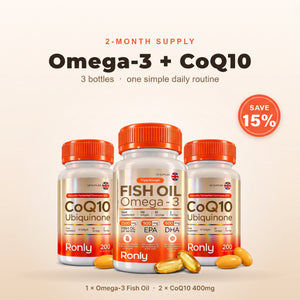
If you'd like to take both, our Omega-3 + CoQ10 Bundle pairs one bottle of omega-3 with two bottles of CoQ10, so both last two months and run out together — for 15% less than buying them separately.
- Ronly CoQ10 400mg with Vitamin E provides 400 mg of naturally fermented CoQ10 (ubiquinone) per 2-softgel serving, plus vitamin E, which contributes to the protection of cells from oxidative stress.
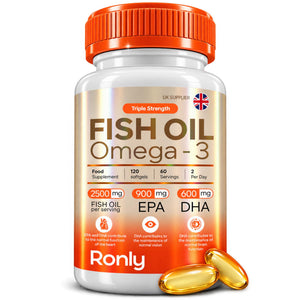
- Ronly Omega-3 Fish Oil Triple Strength provides 900 mg EPA and 600 mg DHA per 2-softgel serving from anchovies and sardines. EPA and DHA contribute to the normal function of the heart (beneficial effect with 250 mg EPA + DHA a day).
Both are made to GMP and HACCP standards for Ronly Health Limited, UK, with free UK delivery.
Food supplements should not be used as a substitute for a varied and balanced diet and a healthy lifestyle. This article is general information, not medical advice. If you take medicines or have a medical condition, speak to your GP or pharmacist before starting a supplement.
References
- Mori TA et al. The effects of ω3 fatty acids and coenzyme Q10 on blood pressure and heart rate in chronic kidney disease: a randomized controlled trial. J Hypertens. 2009;27(9):1863-72. doi:10.1097/hjh.0b013e32832e1bd9
- Mas E et al. A randomized controlled trial of the effects of n-3 fatty acids on resolvins in chronic kidney disease. Clin Nutr. 2016;35(2):331-336. doi:10.1016/j.clnu.2015.04.004
- Barden AE et al. The effect of n-3 fatty acids and coenzyme Q10 supplementation on neutrophil leukotrienes, mediators of inflammation resolution and myeloperoxidase in chronic kidney disease. Prostaglandins Other Lipid Mediat. 2018;136:1-8. doi:10.1016/j.prostaglandins.2018.03.002
- Parker HM et al. Effect of fish oil supplementation on hepatic and visceral fat in overweight men: a randomized controlled trial. Nutrients. 2019;11(2):475. doi:10.3390/nu11020475
- Banach M et al. Statin therapy and plasma coenzyme Q10 concentrations — a systematic review and meta-analysis of placebo-controlled trials. Pharmacol Res. 2015;99:329-36. doi:10.1016/j.phrs.2015.07.008
- Bhagavan HN et al. Assessment of coenzyme Q10 absorption using an in vitro digestion-Caco-2 cell model. Int J Pharm. 2007;333(1-2):112-7. doi:10.1016/j.ijpharm.2006.10.007
- EFSA Panel on Dietetic Products, Nutrition and Allergies. Scientific Opinion on the Tolerable Upper Intake Level of EPA, DHA and DPA. EFSA Journal. 2012;10(7):2815. efsa.europa.eu
Studies retrieved via PubMed.